Showing posts with label movie review. Show all posts

Sunday, July 01, 2012

Createe and Creator in Prometheus (2012)

David - A Createe of Humans
"So God created man in his own image, in the image of God created him; male and female" (Genesis 1:27). Not so, according to Prometheus directed by Ridley Scott. In the beginning, a humanoid - one of our alien ancestors - drank a unknown substance, disintegrated, poured to the great fall and flowed to the ocean - the origin of life.

The secondary question under this origin of life is, no doubt, the human nature to rebel; or, to put it more precisely, the defiance tendency in a createe against a creator. Why did David put the organic substance in the drinks to poison Holloway? Surely, it can't be a little mischief arising from an error in the circuits of android? The motive, we can only guess, from his remarks that children can only kill parents to gain freedom. 

As an android, a createe from human hands, he already acquired the desire for freedom - something that can't be granted by parental obedience but must be fought by defiance and rebellion. We, the creator of android but a createe of unknown God, strive for the same freedom. Adam's eating of the forbidden fruit behind God's back is petty in comparison with Ahab's unholy war against the invincible Moby Dick - a symbolic representation of a fallible human against the infallible Fate or God. Alternatively this defiance is best captured by Nietzsche 's remark: 'God is dead'. 

Less dramatically - yet more enigmatically -  David's act of poisoning seems trivial and unexplained but is it not a simple act, though mischievous in nature, of rebellion against a creator, i.e. us? 

Nevertheless, David, though inherited the defiance from human, will never understand why humans or specifically Elizabeth Shaw want desperately to know the origin of life. With the cross on her neck, she believed life has a divine origin. It is a faith - an irrational belief in impossible thing - that the rational android can not get. Are the white humanoid the creators? How did they create humans? Why did they want to destroy us? 

These questions are meant to be asked, but hopefully to be answered by a sequel. The odyssey continues.

Prometheus is directed by Ridley Scott, written by Jon Spaihts, Damon Lindelof, starring Noomi Rapace, Logan Marshall-Green and Michael Fassbender.

Thursday, June 28, 2012

The Bounty (懸紅) (2012)

Fiona Sit (right) and Chapman To (left) in The Bounty

Bounty hunter, wanted criminal, a small wooden inn in an isolated place and gangsters in a small community are reminiscent  of the lawless Texas in the good  and old American western cowboy movies in the late  1950s, prominently represented by Shane (1953). Yet that's the setting of The Bounty (懸紅) directed by 馮志強, starring Chapman To (杜汶澤) , Fiona Sit (薛凱琪 ) and Alex Man (萬梓良). 

In The Bounty, the ex - police Cho (Chapman To), relying on bounty for living, searched for a wanted criminal that last appeared in a small inn (Lazy Inn) , situated in an isolated island. He found the bizarre innkeeper (Alex Man) and her eccentric daughter (Fiona Sit) during his investigation that sparked off a chain of events, proving to be a challenge for Cho.

The overall red - bricks wall, wooden floor and furnitures, and even the old-fashioned trunk are quite refreshing and complimentary with the brown and tarnished cowboy shirts and jackets of Chapman To; the jockey - styled outfit from Fiona Sit. 

The Bounty is clearly intended with black humour that unfortunately just doesn't work and is bored at times. Fiona Sit's pretty dolly face can't help Chapman To much to start off his usual dark jokes. Alex Man, a very experienced actor indeed, balanced well between humour as the strange innkeeper and the weak fallible father as times required. 

Nevertheless a surprising lot of casts, each playing a small cameo scene, did throw some eye - opening entertainment that added much liveliness to the movie. 

On the bottom line, The Bounty is a refreshing comedy in summer and shows promises for 馮志強 to break from being a mere screenplay writer to a comedy director. 

The trailer: 


Rating: 2.5/5
The Bounty directed by 馮志強, starring Chapman To (杜汶澤) , Fiona Sit (薛凱琪 ) and Alex Man (萬梓良). 

Thursday, May 24, 2012

Men in Black III

Young K, J and Old K

It comes as a surprise to see Men in Black III 10 years after the bad sequel in the Men in Black II for the truly original one in 1997. Still more surprising (for any sequel), it comes out as good as, if not better, than the first Men in Black - part of my childhood memory. 

The basic elements are there: a secretive agency dealing aliens, men wearing black suits and black ties, aliens disguising in human forms and firing space guns and erasing memory with the Neuralyzer. The interesting bit, though, is to know the Neuralyzer initially needs a portable charger - a feeling similar to looking back at the box - like computers back in 20 or 30 years ago. K (Tommy Lee Jones) still carries his no - nonsense businesslike style while J (Will Smith) slipps in with his hype and gags, only with better humour and added force this time. 

One natural extension to this hyper - technology in the film is time travel - an old theme but nonetheless one that always raise interesting questions. This time, J has to jump out from the 319 meter - high  Chrysler Building to travel back to 1969 for saving the young K from Boris the Animal, the nasty alien who escaped from the moon prison and threatened to destroy the Earth with his massive army but for an ArcNet shield K has succeeded to set up. 

Causal relationships always chime in whenever it involves the time travelling. 'What if' something happens, the future will probably change. A simple causal relation here is: if the young K dies, then no one sets up the ArcNet, then Boris will invade the Earth. But what if someone other than K can do the same job? What if Boris changes his mind and invades another planet? What if K did not set up the ArcNet but still survive? Well, who knows. 

A comic twist comes at the final scene when Griffin (who can predict the immediate future by looking at different possibilities resulting from various causes and events) said 'Uh, oh', what if K has forgotten to pay the tip when he left the restaurant? It might be something catastrophic. 

Finally, the movie added a touching dimension between J and K - shedding light why K recruited the young J in the first Men in Black

Tuesday, April 17, 2012

Watching Putin's Kiss, Thinking Hong Kong

Roughly means: Those who beat Oleg Kashin must be brought to justice.
Marsha withdrew from NASHI after Oleg, her friend, has been beaten by two unknown attackers. 
This documentary is about the rise, the struggle, the fall, and eventually the reawakening of Marsha Drokova - an intelligent and enthusiastic, yet young and naive, lady.

What Winston Churchill said in 1939 still prophetically holds true: Russia is a 'riddle, wrapped in a mystery, inside an enigma'. Now Pedersen, the Denmark director, offers Marsha to slightly unwrap that riddle and to help us understand the difference in Russia, if any, after the demise of the noble experiment by Gorbachev. 

Like Hitler Youth in Hitler Germany, Komsomol (Communist Union of Youth) in USSR and 共青團 (Communist Youth League) in China, Putin's Russia institutes NASHI,  a youth movement that seeks to absorb the youth enthusiasm and unleash it to fill up the civil society.

It keeps pondering in my mind of the terrifying consequence after the state has gained power to use the media as the state apparatus. The spontaneous harassments from youths (ranging from excreting on the opposition leader's car in public to flying dildos in meeting during an activist's talk), large buses travelling youths from subburg to Moscow for a mass denunciation of enemies and finally the near fatal attack of Oleg Kashin, a critical journalist against Putin, only serve to show a simple logic: 'You are either with Putin or the enemy.'

Notwithstanding using his name as the title, Putin rarely appeared on screen, saved for a few seconds here or there. Yet, his absence only amplifies his presence throughout the whole film,  more like the Big Brother is watching you. 

I can't help but to relate back to Hong Kong. The police's frequent use of pepper spray, setting up barricades against a dozen kids and recently laying a discriminatory media zone at the Central Liaison Office seems to me resonating the use of state power against different yet legitimate voices.

Fortunately the media in Hong Kong is still free but similar signs show up. As one opposition leader has put it in the film, 'you are not treated as opposition, but rather as an enemy'. 文匯報 (Wen Wei Pao), with article like this, is denouncing the opposition from barristers in the Civic Party almost as 反中亂港 ('anti - China, meddling HK'), instead of seeing them as contributing a different opinion to social problems.

The film closes with a casual chat between Marsha who has already withdrawn from NASHI and Oleg who has managed to survive the fatal attack.  Still an ardent believer in Putin, Marsha described him as a saviour 'sent to Russia by God', in which Oleg wryly said only as 'an angel of the Apocalypse.'

This is the only moment where different opinions are voiced out in such casual chat and with such mutual respect. 

Friday, April 06, 2012

House of Tolerance (L'Apollonide: Souvenirs de la maison close)

waiting for their clients at night. 

This is a very very sad story or stories of women

The glory of la belle Époque in the 1900 - the age of photograph, automobile and aeroplane - shines so bright that cast a long shadow over a forgotten group of people - the prostitutes. 

The lush setting - soft sofa, richly woven carpet, exotic oriental painting - and subtle yellow light that lowly illuminates the classic Roman architecture were unfortunately tainted with the smell of champagne and perhaps unavoidably sperm. 

The director's documentary attention to details renders Memoir of Geisha like a pulp fiction while the lavish setting adds a richly texture element that Whispers And Moans (性工作者十日談) does not have.

That is the House of Tolerance, the place where the high - ends prostitutes 'do business', live and get abused. 'Can I tie you up?' asked a rich client. 'Yes, you may', Madeleine or the 'Jewess' answered. Time passed and a cry was heard. Madeleine was found on the bed with her cheek sliced open from the lips. Now she became known as la femme qui rit or the woman who laughs. 

Hiding her disfigured face behind a veil, she became a popular 'amusement' for social gathering - someone to be looked with surprise, curiosity and laugh. 

Men find (or they thought they do) pleasure and sex in this House of Tolerance. More often, they fill up their empty spirits with bizarre pleasure. In one scene, one asks the woman to pretend a Geisha which is still within normal confinement. 

In another scene, the man wants the woman to act like automation - a poupée. He wants her to move in a mechanic way and eventually has intercourse with this poupée, silently and dispassionately. 

The film closed with the opening of the Metro and the Day of Bastille - the French national day - while a party was gathering at the House of Tolerance. The flip side of civilisation is the decadence that often rests on the shoulders of prostitutes - victims of abuse, entrapment and helplessness. 

The irony bites when at the final scene, the hookers were shown on the street of modern Paris. Perhaps we need prostitutes or sexual workers, to be respectful, for civilisation to continue shining. Or to use the words of the women in the film, they were 'burnt' to let the men glow. 

(Below is the Right to Love by the Mighty Hannibal - an extremely sensational song that fits perfectly into the film) 


Tuesday, February 28, 2012

The Lady

The Lady


Imagine this. 


One afternoon,  a group of badly wounded students flood in the hospital and spotting a student with a bleeding arm, you rush to give him emergency aid. A man in uniform grabs you from behind and tries to drag him out. 

'What? Don't you see he is bleeding?' 
'Let him go, or I will shoot you. Don't you see this red scarf? I have the right to shoot you!' 

And a gunshot was heard,  with your arm bleeding this time. 

This is what happened in the opening scene of The Lady where in Burma, soldier with red scarf can have the right to shoot anyone on the street. 

Witnessing this comes the moment for Aung San Suu Kyi (Michelle Yeoh) to decide in continuing her father's legacy to fight for democracy or to continue living as a peaceful, somewhat unenlightened, housewife life. 

Michelle Yeoh  in this movie has truly transformed herself from a more or less stereotypical Chinese kungfu star in Crouching Tiger and Hidden Dragon to the softly - spoken yet with intense inner strength 'Steel Orchid' - Aung San Suu Kyi.

Undaunted by soldiers' gun pointing, she passed through them without even lifting a look  - that shows not the slightest hint of arrogance but a simple civil disobedience that reminds me of Gandhi (whose biography was widely read in the movie by Suu Kyi  and other students). 

It was a pity for this great cast to have fallen into the hand of Luc Besson. Besson seems to be more apt to  direct film like the action - bursting Fifth Element but definitely not for this slow sentimental drama. 

The static house arrest and the dry bureaucratic exchange, along with the constant frustration of getting connected in either telephone line or radio, can hardly sustain the momentum of the movie, saved by occasional intensely sentimental exchanges between Suu Kyi and her husband, Michael. 

In any case, the causes, namely democracy and rule of law, that Aung San Suu Kyi fought for and has paid a dear price for doing so (years of solitude in house arrest and the pain of separation with Michael who can't even see her in his dying bed) are what you and me are enjoying now; that's we won't get punched or shot on the street by someone who wears red scarf. 

Saturday, February 18, 2012

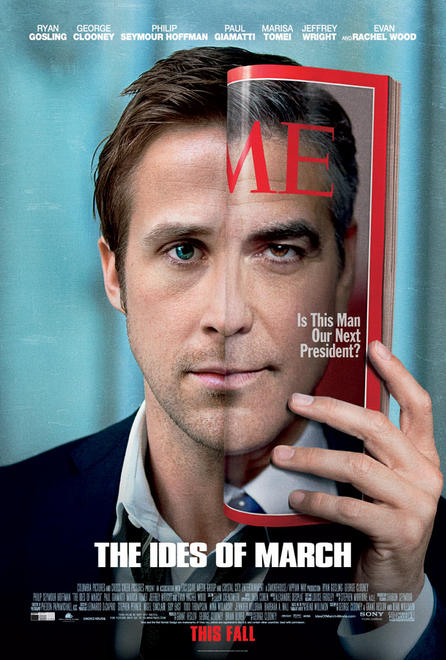
The Ides of March

The Ides of March
Two days ago, Henry Tang slacked off all the blame on the illegal basement to Mrs. Tang. "It's all my fault, not my husband" is what seems to be saying in Mrs.Tang's quiet weeping.

This total fisco just doubly proves how dirty the political world is, and that's what The Ides of March told us about. 

Stephen Meyers (Ryan Gosling) is the press secretary of Mike Morris (George Clooney), the governor of Pennsylvania and the Democrat presidential candidate. The story starts when Stephen, lacking political sensitivity, went out to meet the competitor's campaign manager. 

He belatedly told his boss, Paul Zara (Philip Seymour Hoffman) about the meeting but this honesty was not very much appreciated; Paul distrusted and fired him. That starts Stephen's revenge which eventually turned him into a soulless amoral person. 

This plot bespeaks a tragic moral fable. The most chilling scene is when Ida, the journalist who threatened Stephen to publish his meeting, came after Stephen has emerged unscratched by the scandal and asked him  'Hey, Steve. I'm still your friend, right?'

Without irony nor any emotion, he replied 'You are my best friend' - the ultimate descent to hypocrisy. 

George Clooney easily executed a relaxing judicious authority as what a governor should do. He listened to advices, asked the advisers and made his own mind. When asked about his view on capital punishment and what if the victim is his wife, he answered, without a moment of thinking, that he would kill the murderer.

Despite that, he is still against capital punishment, since 'The society must be better than the individual'. (Professor Choy has written a fantastic article on this here)

But this idealism is all too superficial when on the face of Stephen's threat, Morris simply gave up all his baselines. After all, a politician has no baseline in a political game, especially in an election running for the most powerful seat in the world.

In the political world, everything can be bought and sold for power; just like Henry Tang selling out his wife to continue running the CE election. 

Monday, December 26, 2011

Movie Review: 龍門飛甲 (The Flying Swords of Dragon Gate)

The Flying Swords of Dragon Gate

Director: Tsui Hark
Cast: Jet Li, Zhou Xun, Chen Kun, Kwai Lun - mei and Li Yu - chun
Overall: 7.5/10
Spoiler Warning: Minimal. 

Continuing his theme in Detective Dee and the Mystery of Phantom Flame last year,  Tsui Hark in The Flying Swords of Dragon Gate tells us one simple truth: power corrupts and perishes while trust and love, the Wuxia values, last.

In contrast to the all too realistic fighting in Ip Man, you'll see swords, flying daggers, chains and sharp silk lines whirling in the air. As Wuxia master, Chow Wai - on (Jet Li) elegantly fights with sword, while the devious Eunuch Yu Hua - tian (Chen Kun) hides his sword under his flipping robe. 

Still the beautiful Tartars Princess (Kwai Lun-mei) close - fights with a style akin to the Mongolian wrestling and also fights with a crescent that again tries to engage enemies as closely possible. Further, Gu Shaotang (Li Yu - chun) threw daggers that fly in a predictably unpredictable course. 

All these are done under the 3D effect which is not great, but acceptable. The 3D is still crude and undeveloped and it can hardly accomodate all the spinning and swirling of weapons and people. Nevertheless it does give some eye - opening surprises, particularly when Chow broke through the flag to kill  the Eunuch at the opening. 

Despite the martial art and the 3D effect, the plot is so weak that it renders all the characters as two - dimensional flat sheets. We never really know what has happened in the love story between Chow and Ling Yan - qiu (Zhou Xun), nor do we know how others have come together for the treasure hunt. 

Fortunately this did not stop Chen Kun playing the scheming Eunuch on one hand, and the blissful Wind Blade, on the other. The parts where Chen imitated the Eunuch to fool other people has added much lively element in the middle of the movie. Kwai has also unusually plays well the passion of the Tartars people.

Tsui interestingly put the very traditional Wuxia music, Dagger Society Prelude (小刀會序曲), at the opening and closing scenes, perhaps at a tribute to old Wuxia movies. 

The movie ends with the Eunuch, symbolizing lust for power and wealth, buried deep in the sand, while Chow has taken his turn to find his love, Ling, till the end of the world. In the world of Wuxia, love is perennial. 

Monday, December 05, 2011

Movie Review: The Adventures of Tin Tin: Secret of the Unicorn

Tin Tin and Snowy

Director: Steven Spielberg
Cast: Jamie Bell (as Tin Tin), Daniel Craig (as Red Rackham), Andy Serkis (as Captain Haddock)
Overall: 7/10
Spoiler Warning: Minimal

Born in Brussels, Tin Tin is a young intelligent journalist who undauntedly goes up to space and down to the ocean for the quest of truth. Unlike the flying batman, swinging spiderman or the ultra muscular superman, Tin Tin possesses no special talent but his insatiable curiosity and enormous courage to find the truth. This pretty much represents the down to earth Greco-European culture, in stark contrast with the vulgar American culture

It is then ironical for Spielberg, the all famous American director, to breath new life into Tin Tin from Hergé's renowned two dimensional ligne claire into three dimensional quasi - animation.

Spielberg and Peter Jackson produce an animation so realistic that it can't really be called an animation. The use of performance/motion capture technique (or mocap) literally captures the live movement of Jamie Bell (as Tin Tin) and Daniel Craig (as Red Rackham) that melts effortlessly into the animated background. It is  also a delight to see how the computer - generated water react realistically with the computer - generated cloth in the movie. 

The Star Wars saga music composer John Williams (another American) has also appropriately departed from his grandiose style in Star Wars and Harry Potter and has instead incorporated many lively elements. The musical theme accompanying the appearance of Thomson and Thompson is particularly relieving and can be a perfect piece of atmospheric music in a lazy afternoon.

The only drawback, as a lover of Tin Tin since as a child in Montreal, is that everything is real, all too real. The realness achieved by mocap is itself the greatest defect that renders one of Tin Tin's most famous characteristics; namely the two dimensional ligne claire void.

After all, it's not so ironical for an American to make an essentially European cultural icon into movie; the Europeans create the culture, only left to the Americans to destroy and (hopefully) remake. 

Monday, October 10, 2011

Movie Review: 白蛇傳說 (The Sorcerer and the White Snake)

白蛇傳說 


Director: Ching siu - tong
Cast: Jet Li (as Fa Hai), Eva Huang (as White Snake), Charlene Tsoi (as Green Snake) and Raymond Lam (as Xu Xian)
Overall: 6/10
Spoiler Warning: Yes

The very story incurs me to make a comparison with Green Snake, directed by Tsui Hark starring Joey Wong as White Snake and Cheung man - yuk (or Maggie Cheung as she is now better known) as Green Snake.

Both basing their movies on the classical Legend of the White Snake, Ching tries to visualise all the supernatural powers, tsunamis, fights of the Fa Hai with the giants monsters and snakes with the CG technology but end ups with crude visual effects that almost wreck the movie altogether. The half - human half - snake looks of Eva Huang and Charlene Tsoi are horrible sights to human eyes.

During the time of making his movie (in the 80s), there wasn't so much CG technology available and so Tsui Hark relies on light, colours and illusions to beautifully show the mystical atmosphere throughout the whole movie. While Ching hopelessly uses the computer technology to present realistic scenes, Tsui unscrupulously perpetuates mysteries in a myth.

Ching made attempts to integrate some western elements in this Chinese myth. Turtles, rabbits, giant bat are all examples. The fight between Fa Hai and the giant bat monster in the volcanic mountain reminds me of the one between Gandalf and Balrog in the The Lord of the Rings: The Fellowship of the Rings (but again, the CG effect seriously hampers the quality). It seems quite refreshing at certain times, especially the scene where Xu Xian goes to see 'relatives' (the badly disguised rabbit, turtle, and reptile) of White for marriage. But at other times, the overall effect is weird and even quite anti - climatic, like when the rats easily break the spells of the monks by biting them.

青蛇
(Green Snake)
Instead of putting something else into a melange, the Indian ball dance in the opening scene already shows how Tsui Hark merge exotic elements with the seductiveness of snake. Rain with lightning, the strange metallic Indian music coupled with the laughters of men and women arouses Green from the deep lake to crawl onto the roof to have a look inside. Eager to participate, she transformes into human form, half naked, and danced with the other Indian dancers (This scene is still available in YouTube, here). This is one of many other scenes to show how seductive the snakes are (especially Maggie Cheung at her prime time) but also the decadences of the people at the time.


Time and space only permit me to compare the visual arts. Let me deal with the character and plot in the next entry.