Thursday, May 24, 2012

Men in Black III

Young K, J and Old K

It comes as a surprise to see Men in Black III 10 years after the bad sequel in the Men in Black II for the truly original one in 1997. Still more surprising (for any sequel), it comes out as good as, if not better, than the first Men in Black - part of my childhood memory. 

The basic elements are there: a secretive agency dealing aliens, men wearing black suits and black ties, aliens disguising in human forms and firing space guns and erasing memory with the Neuralyzer. The interesting bit, though, is to know the Neuralyzer initially needs a portable charger - a feeling similar to looking back at the box - like computers back in 20 or 30 years ago. K (Tommy Lee Jones) still carries his no - nonsense businesslike style while J (Will Smith) slipps in with his hype and gags, only with better humour and added force this time. 

One natural extension to this hyper - technology in the film is time travel - an old theme but nonetheless one that always raise interesting questions. This time, J has to jump out from the 319 meter - high  Chrysler Building to travel back to 1969 for saving the young K from Boris the Animal, the nasty alien who escaped from the moon prison and threatened to destroy the Earth with his massive army but for an ArcNet shield K has succeeded to set up. 

Causal relationships always chime in whenever it involves the time travelling. 'What if' something happens, the future will probably change. A simple causal relation here is: if the young K dies, then no one sets up the ArcNet, then Boris will invade the Earth. But what if someone other than K can do the same job? What if Boris changes his mind and invades another planet? What if K did not set up the ArcNet but still survive? Well, who knows. 

A comic twist comes at the final scene when Griffin (who can predict the immediate future by looking at different possibilities resulting from various causes and events) said 'Uh, oh', what if K has forgotten to pay the tip when he left the restaurant? It might be something catastrophic. 

Finally, the movie added a touching dimension between J and K - shedding light why K recruited the young J in the first Men in Black. 

Sunday, May 20, 2012

The Murders in the Rue Morgue

The Murders in the Rue Morgue

"They are puzzled, too, by the seeming impossibility of reconciling the voices heard in contention, with the facts that no one was discovered upstairs but the assassinated Mademoiselle L'Espanaye, and that there were no means of egress without the notice of the party ascending. The wild disorder of the room; the corpse thrust, with the head downward, up the chimney; the frightful mutilation of the body of the old lady; these considerations, with those just mentioned, and others which I need not mention, have sufficed to paralyze the powers, by putting completely at fault the boasted acumen, of the government agents. They have fallen into the gross but common error of confounding the unusual with the abstruse.

But it is by these deviations from the plane of the ordinary, that reason feels its way, if at all, in its search for the true. In investigations such as we are now pursuing, it should not be so much asked `what has occurred,' as `what has occurred that has never occurred before.' In fact, the facility with which I shall arrive, or have arrived, at the solution of this mystery, is in the direct ration of its apparent insolubility in the eyes of the police." I stared at the speaker in mute astonishment.

Sunday, May 13, 2012

七種武器之 拳頭


小馬道:"但是痛苦也能使人保持清醒。 "

痛苦也能使人清醒。 
人活著,就有痛苦.
那本是誰都無法避免的事。
你若能記住這句話,你一定會活得更堅強些,更愉快些。
因為你漸漸就會發覺,只有一個能在清醒中忍受痛苦的人.他的生命才有意義,他的人格才值得尊敬。

Tuesday, April 24, 2012

A Few Words on Titus Andronicus

'If one good deed in all my life I did, I do repent it from my very soul' said Aaron the Moor


Rape, murder, human sacrifice and cannibalism are the last things you'll associate with William Shakespeare, and yet, that's what Titus Andronicus is about. 

In essence, the plot is the revenge of Titus Andronicus, the glorious Roman general who lost 22 sons to conquer the Goths, against the villainous Aaron, sadistic Chiron and Demetrius and the scheming Tamora (Queen of the Roman Emperor). 

The violence starts when Titus insisted on taking Alarbus as sacrifice for his 22 lost sons in the war, despite a strong pitiful plead from the mother - Tamora. Aaron, out of pure vice, plotted with Chiron and Demetrius - Tamora's remaining sons, to put Titus' two sons to deaths and to get Lavina raped and have her tongue and hands cut off - as an attempt to prevent her uttering the rapists' names. 

Titus eventually found Chiron and Demetrius as the wrongdoers. He killed them, ground their bones, mixed their blood and meat into paste, and served it to their mother at banquet. Aaron was later buried and starved to death. 

The distinction between the civilised Roman and barbarous Goth blurred. Titus' killing Alarbus as sacrifice, then serving the sons' cooked flesh to mother is no less horrible than Demetrius and Chiron raping and then mutilating a girl they supposedly love.

Like the love of Romeo and Juliet and indecisiveness of Hamlet, Shakespeare's Titus Andronicus presents yet another universal life theme: the endless cycle of revenges. When Titus started the human sacrifice,  the whirlpool of revenges begins to draw everyone in

This whirlpool of revenges, along with the blurred line between civilisation and barbarism, bear such striking relevance to today context that once again proves the timelessness of Shakespeare. American involvement in the Middle East, notably the support for the repressive Bahrain, and the subsequent pursue of the al Qaeda only serve to remind me of Titus and the Goths.

'Justice has been done' said Barack Obama to the killing of Osama Bin Laden. I doubt that.

Indeed, the point here is not justice as such but the endless rounds of revenges that trap people into a quagmire.

Forgive and forget is easier said than done. But that's what Titus Andronicus warned us to do. 

Tuesday, April 17, 2012

Watching Putin's Kiss, Thinking Hong Kong

Roughly means: Those who beat Oleg Kashin must be brought to justice.
Marsha withdrew from NASHI after Oleg, her friend, has been beaten by two unknown attackers. 
This documentary is about the rise, the struggle, the fall, and eventually the reawakening of Marsha Drokova - an intelligent and enthusiastic, yet young and naive, lady.

What Winston Churchill said in 1939 still prophetically holds true: Russia is a 'riddle, wrapped in a mystery, inside an enigma'. Now Pedersen, the Denmark director, offers Marsha to slightly unwrap that riddle and to help us understand the difference in Russia, if any, after the demise of the noble experiment by Gorbachev. 

Like Hitler Youth in Hitler Germany, Komsomol (Communist Union of Youth) in USSR and 共青團 (Communist Youth League) in China, Putin's Russia institutes NASHI,  a youth movement that seeks to absorb the youth enthusiasm and unleash it to fill up the civil society.

It keeps pondering in my mind of the terrifying consequence after the state has gained power to use the media as the state apparatus. The spontaneous harassments from youths (ranging from excreting on the opposition leader's car in public to flying dildos in meeting during an activist's talk), large buses travelling youths from subburg to Moscow for a mass denunciation of enemies and finally the near fatal attack of Oleg Kashin, a critical journalist against Putin, only serve to show a simple logic: 'You are either with Putin or the enemy.'

Notwithstanding using his name as the title, Putin rarely appeared on screen, saved for a few seconds here or there. Yet, his absence only amplifies his presence throughout the whole film,  more like the Big Brother is watching you. 

I can't help but to relate back to Hong Kong. The police's frequent use of pepper spray, setting up barricades against a dozen kids and recently laying a discriminatory media zone at the Central Liaison Office seems to me resonating the use of state power against different yet legitimate voices.

Fortunately the media in Hong Kong is still free but similar signs show up. As one opposition leader has put it in the film, 'you are not treated as opposition, but rather as an enemy'. 文匯報 (Wen Wei Pao), with article like this, is denouncing the opposition from barristers in the Civic Party almost as 反中亂港 ('anti - China, meddling HK'), instead of seeing them as contributing a different opinion to social problems.

The film closes with a casual chat between Marsha who has already withdrawn from NASHI and Oleg who has managed to survive the fatal attack.  Still an ardent believer in Putin, Marsha described him as a saviour 'sent to Russia by God', in which Oleg wryly said only as 'an angel of the Apocalypse.'

This is the only moment where different opinions are voiced out in such casual chat and with such mutual respect. 

Friday, April 06, 2012

House of Tolerance (L'Apollonide: Souvenirs de la maison close)

waiting for their clients at night. 

This is a very very sad story or stories of women

The glory of la belle Époque in the 1900 - the age of photograph, automobile and aeroplane - shines so bright that cast a long shadow over a forgotten group of people - the prostitutes. 

The lush setting - soft sofa, richly woven carpet, exotic oriental painting - and subtle yellow light that lowly illuminates the classic Roman architecture were unfortunately tainted with the smell of champagne and perhaps unavoidably sperm. 

The director's documentary attention to details renders Memoir of Geisha like a pulp fiction while the lavish setting adds a richly texture element that Whispers And Moans (性工作者十日談) does not have.

That is the House of Tolerance, the place where the high - ends prostitutes 'do business', live and get abused. 'Can I tie you up?' asked a rich client. 'Yes, you may', Madeleine or the 'Jewess' answered. Time passed and a cry was heard. Madeleine was found on the bed with her cheek sliced open from the lips. Now she became known as la femme qui rit or the woman who laughs. 

Hiding her disfigured face behind a veil, she became a popular 'amusement' for social gathering - someone to be looked with surprise, curiosity and laugh. 

Men find (or they thought they do) pleasure and sex in this House of Tolerance. More often, they fill up their empty spirits with bizarre pleasure. In one scene, one asks the woman to pretend a Geisha which is still within normal confinement. 

In another scene, the man wants the woman to act like automation - a poupée. He wants her to move in a mechanic way and eventually has intercourse with this poupée, silently and dispassionately. 

The film closed with the opening of the Metro and the Day of Bastille - the French national day - while a party was gathering at the House of Tolerance. The flip side of civilisation is the decadence that often rests on the shoulders of prostitutes - victims of abuse, entrapment and helplessness. 

The irony bites when at the final scene, the hookers were shown on the street of modern Paris. Perhaps we need prostitutes or sexual workers, to be respectful, for civilisation to continue shining. Or to use the words of the women in the film, they were 'burnt' to let the men glow. 

(Below is the Right to Love by the Mighty Hannibal - an extremely sensational song that fits perfectly into the film) 


Saturday, March 24, 2012

325: 'Heil, mein Führer! Mr. Leung Chun - ying'

'Heil, mein Führer! Mr Leung Chun - ying' 


325.  The play has come to the final moment.  'Heil, mein Führer! Let's give a round of warm applause to our new CE, Mr. Leung Chun - ying' 

'There would be one day [when] Hong Kong would eventually need to dispatch the anti-riot police and utilise tear gas to handle protests' said CY - an accusation made by Henry Tang in his final rebound against his arch - rival. 

Can we trust Henry? My answer is Why not? He has come to his own political suicide anyway. There's no reason not to trust a dying person. 

This blatant tramping on freedom of speech by CY is not so surprising, after we have read Mdm. Ip's article, saying CY has always been a underground communist. 

Indeed PRC has long known how to play the filtration game. CY as underground communist can't be something too far - fetched to believe in when other scholars already explored how PRC set up parallel organisations to plant their own support ( in Associations in a Bind by Jonathan Unger and Anita Chan). 

Undoubtedly, PRC also masters the Shakespearian play within a play in writing the drama script for Hong Kong. Right of abode cases, Article 23, double - non issues and now CE election are all mini - plays within the grand play - the ultimate death of One Country Two Systems. 

Shortly gaining his chancellorship on January 30 1933, Hitler unleashed his Night of Long Knives - purging the internal dissidents and killing off other political opponents.

CY promised to pursue the matter about accusation made by Henry Tang further after the election is over. 

The only vain hope I am holding now is a deus ex machina - a totally unexpected event - that will produce enough blank votes  to make an abortive election. ABC. Anything But CY. 

This hope is, however, hopeless. The red curtain will be drawn, with blood seeping beneath it. HK is dead.

Sunday, March 18, 2012

1920s - Sophisticated Elegance

Audrey Hepburn in Breakfast at Tiffany's
Casually holding her cigarette, Holly Golightly gazes at the camera with her careless confidence. Sophisticated, elegant are the words to describe her - the exact words 1920s falls into – sophisticated elegance. 

Carefully combed hair, perfectly fit tuxedo and casual decadent flappers are only ones of the many example of this sophisticated elegance. Glenn Miller's Jazz music, Scott Joplin's rag time (e.g. the all famous  Entertainer, originally composed as soundtrack for The Sting),  Peg Leg Bates' one legged tap dancing show all the excitement and hype of the Roaring Twenties.

All these aren't too far away from us when The Artist and Midnight in Paris - all set in the 1920s - found their way in nowadays cinema

The black and white silence in The Artist does not dampen any interests but only serve to remind us in this midst of vulgar CG effect or blind production of 3D movies what we want is only sincere originality - something that long ceases to exist since the 1920s.

In a slightly different context, Midnight in Paris recounted all the buzz and noise of the Americans on the French soil. Meeting writers as eminent as Hemingway and Fitzgerald in person in the movie is like taking a trip by time machine back to the 1920s

The dazzling bright light of this Roaring Twenties casts a long shadow of decadence which is all the more attractive. I can not but to lend Fitzgerald's words in The Great Gatsby to describe it:

"Every Friday five crates of oranges and lemons arrived from a fruiteer in New York -  Every Monday these same oranges and lemons left his back door in a pyramid of pulpless halves. There was a machine in the kitchen which could extract the juice of two hundred oranges in half an hour if a little button was pressed two hundred times by a butler's thumb.


At least once a fortnight a corps of caters came down with several hundred feet of canvas and enough coloured lights to make a Christmas tree of Gatsby 's enormous garden. On buffet tables, garnished with glistening hors - d'oeuvre, spiced baked hams crowded against salads of harlequin designs and pastry pigs and turkeys bewitched to a dark gold. In the main hall a bar with a real brass rail was set up, and stocked with gins and liquors and with cordials so long forgotten that most of his female guests were too young to know one from another. 


By seven o'clock the orchestra has arrived, no thin five - piece affair, but a whole pitful of oboes and trombones and saxophones and viols and cornets and piccolos, and low and high drums. The last swimmers have come in from the breach now and are dressing upstairs; the cars from New York are parked five deep in the drive, and already the halls and salons and verandas are gaudy with primary colours, and hair bobbed in strange new ways, and shawls beyond the dreams of Castile. The bar is in full swing, and floating rounds of cocktails permeate the garden outside, until the air is alive with chatter and laughter, and casual innuendo and introduction forgotten on the sport, and enthusiastic meetings between women who never knew each other's names. "

The lavish waste, heavy percussion jazz and chaotic chats do not suggest any of the moral decay ( if there is such thing as morality) but only the beauty of decadence.

Reaching the peak, this Golden Age, like all other advanced civilisations, is destined to a downfall – opening the door for Wall Street Crash, the Great Depression, chaos, bloodshed and massacre from the Second World War. 

Saturday, March 10, 2012

A Rendezvous at 謝記魚蛋 and 美而廉

山窿謝記魚蛋
This is no industrialized production of the Tsui Wah  fish noodle (翠華) - where the food ingredients are made in bundles of plastic bags at a factory somewhere in the Mainland.

This is 山窿謝記魚蛋 (literally Tse Kei Fish Ball at Cave). Carefully selecting three kind of fishes, Mrs. Tse makes fish balls, fish slice and fish skin everyday which will all be sold out by midday.

The ones I like the most, and also the one I have to fight for before they are sold out again, are the fried fish balls and fried fish slice. The crispiness at the outermost layer just works hand in gloves with the fresh fish meat to produce the 'springy' texture within your mouth.

The good and old fashioned menue
Sadly, this place is going to close by the end of this March due to inflation, lack of fresh fish supply and lack of people with the same insistence to continue the business anymore.

Another truly representing Hong Kong food, 美而廉 (literally Good and Cheap) is sliding into sunset as well. In there, you see old folks running here and there, busy serving dishes, piling glass and heavy metal plate on top of their arms - an acrobatic feat akin to performances in La Cirque du Soleil. 

And here they are - delivering my mélange of sausage, grilled pork and  sirloins steak, along with a glass of lemon coke, on a hot cow - shaped metal plate. When the old folk pour the pepper sauce, the metal plate sizzles, with vapour and smoke rising up in the air.

The unpretentious melange

My mom said when she was at my age, 美而廉 was a fashionable place where young people went to have a steak after clubbing. Now the long queu of people at the front, most of them in 20s or early 30s, testifies after 20 or 30 years, this is still the fashionable place where people go to have a steak.

I look back. With briskness, the old folks move but with sadness, they’ll leave jobless, sooner or later. This place, like 山窿謝記魚蛋, is going to close soon - at late April. 

With the old culture fading, what will fill this up? With the industrialized mass production of fast food from Café de Coral (大家樂) or with the army of amorphous waiters at Tsui Wah? I know not.  

Friday, March 09, 2012

宇宙入門(A Brief History of Time)

蕭公子若元先生博學強識,久慕矣,言有堪讀之書五,曰蘇菲的世界(哲學),EQ(處世),人性的弱點(處世),自私的基因(生物),時間簡史(格致)。既往圖書館,見簡史薄如此,遂借閱之。

時間簡史(A Brief History of Time - From the Big Bang to Black Holes)
簡史著書者何人?霍金(Stephen W. Hawking)也,其上智通天,沈鬱之思,自不待言,劍橋大學盧卡斯數學教授之名(Lucasian Chair of Mathematics)終不枉也。然此書非為深晦,以傲同儕,乃盡其淺白,以悅庶民。蓋宇宙演化,其良有以,百代賢達,莫不欲解。霍金曰,二千年之功,雖未之竟,亦不遠也,故欲撫今追昔,一曉大眾以天文格致之要義,使咸知大爆炸(Big Bang)夸克(quark)量子(quantum)黑洞(black hole)之為何物。


宇宙為何?羅素(Bertrand Russell)嘗授之。既畢,有老婦詰難曰:「汝言謬矣!世界實為一大平板,置於一大龜背上!」羅不以為謗訕,曰:「然則龜立足何地耶?」婦曰:「汝不知耶!龜立於龜,龜立於龜,龜龜相累,成一龜塔,世界在龜塔頂。」龜塔之說,固可笑也。然科學亦未必中。惟理以其可證偽為佳,以其基於任意元素(arbitrary elements)而能解現狀,測來者為上。龜塔未足解現狀,更弗能預知者,故非佳理也。平板之說,阿里士多德(Aristotle)早知其訛矣,一曰地影於月圓,而非橢圓,二曰極星在天,愈南而愈近地,三則眾所周知也,舟至遠方來,先見其桅,後現其身,舟向遠方去,先沒其身,後隱其桅。此地圓說之合乎現象,亦能預知舟向西行,終至原處。然阿君持地心說,日月星辰環之而周旋,直至哥伯尼(Copernicus)開普勒(Kepler)伽利略(Galileo)等方知日之為心,地之為其周旋矣。伽君又知物無輕重,墜地同速(acceleration),此為後羽錘實驗所證矣。基於伽君之見,牛頓(Newton)遂得其引力定律(law of universal gravitation),力所以變物速,非惟變動靜耳。牛君遂疑絕對位置(absolute position)之無有,卻未之敢破,為駭俗甚矣。至乎愛恩斯坦(Einstein),更破絕對時間(absolute time)之說,質能可換(見下圖),時空相關,此所謂「攣生子佯謬」(twin paradox)。愛君惡「不確定性原理」(uncertainty principle)及其所生之「量子力學」(quantum mechanics),堅持宇宙靜止,訂一「宇宙常數」(cosmological constant),成其敗筆。實則宇宙正增大也,由紅移(red shift)見得,大爆炸之說,亦由宇宙中殘存之微波輻射驗之。最可笑者,愛君所以得諾貝爾獎,為其有功於量子力學之發榮也哉!

全書唯一方程式。霍金謂,方程式加一,讀者減半。
至於全書所重,霍金所鑽研者,黑洞,時間箭頭(time arrow),時間旅行(time travel)等,玄之又玄,智力所限,未得其門。諸君自探尋之。
快哉。久耽於課文,復疲於比來政界無窮盡之權術紛爭,覽勝天界,意趣深遠。讀罷全書,僅得其十一,又十一之中,多是高中之所授,不為吾之領會。然知之為知之,不知為不知,是知也。不啻一美妙的問道。
至於宗教,霍金亦言及。時間(time)有始乎?從何而始?有終乎?至何而終?時間之為時間,自大爆炸而始,大爆炸前無時間,此所謂時間之有限而無界(no boundary condition)。故霍金笑言,天主教之曰「上帝創生之時刻」,乃一無有之概念。惟科學終未斷言「上帝」之無有。愛恩斯坦曰:
God doesn’t play dice.
To know that what is impenetrable to us really exists, manifesting itself as the highest wisdom and the most radiant beauty which our dull faculties can comprehend only in their primitive forms – this knowledge, this feeling is at the center of true religiousness.
「上帝」或存或不存焉。存,亦一嚴自律之「上帝」,既創制度,則終身守之,不似曾蔭權之自由而不自察,所訂(潛)規則,只適用於己身,又不從之,使曾蔭權為「上帝」,天下覆滅矣。日月盈昃,辰宿列張,未必不為神祗所司,然其所司,皆有所本,知其所本,科學之務。知曾蔭權所奉行,政客勞之。
結語曰:俾吾儕得一通理,而天下莫不知之,則哲學家科學家至凡人,盡可問宇宙及吾人之所以存,得之,則理智(ration)畢其全功,是知「上帝之精神」(God’s mind)也。


科學與上帝,君信何?

Sunday, March 04, 2012

Le Voyage dans la Lune

The restored version of the well - known moon with the spaceship on his eye
As the only celestial body shining as bright as the sun at night, moon has spurred imagination since the first human and many generations thereafter. The ancient Egyptians have even explained the moon wanes every night all because of a gamble. 

To win extra days, Thoth gambled with Khonsu, the moon, who lost so much light to Thoth, that Thoth used those light to gain 5 days and that, of course, explained why the moon wanes every night.

This fascination toward the moon had continued well beyond  the centuries and found its way to marry with poetic scientific spirit to produce Jules Verne’s From the Earth to the Moon and  H.G Wells' The First Men in the Moon. 

George Méliès, the French illusionist and the greatest fantasy filmaker of all time,  in turn based on these two works to make  Le Voyage dans la Lune in 1902, the pioneer of modern fantasy film, and also the origin of the most memorable cinematic picture of the spaceship landing on the eye of the moon.

In Le Voyage dans la Lune, you not only see the moon with an bleeding eye but also scientists in astronomer robes, spaceship like bullet, umbrella turning into giant mushroom and Selenites (green moon men) vanishing into red gas.
Scientists in astronomer robes

This once black and white silent film is not black and white and silent anymore when Méliès's hand - painted footage was found and was painstakingly restored into full coloured version with new original scores from the French band, Air.

Air with its already distinctive electronic music in Moon Safari seems like a little ironical twist to complete the circle in composing music for Le Voyage dans la Lune. Indeed the band fully took advantages of the silence in the film and made the bombastic music for the 'trip' to and adventure in the moon (Sonic Armada) while dream - like music for the wonder of night and stars (Who am I now?).

Umbrella turns into mushroom 
Wonderful though the music is, it can never overshadow the innovative film techniques that Méliès dared to experiment during the fin de siècle.

The special effect for which the umbrella transforming into giant mushroom and Selenites turning into a puff of red gas is done by stop - camera technique (which is to film the object, turn the camera off, remove the object, and then turn the camera back on - the object will seem disappear for the viewer)

The landing of the spaceship is done by moving the moon closer to the static camera, so that this could achieve a long forward travelling effect. All these techniques were so innovative at the time that they were comparable to the 3D effect in the Avatar. 

The actual landing of the moon in 1969 (67 years after the film)  has done nothing to dampen imagination toward the moon (for example - Apollo 18 made in 2011, a movie about alien life on moon). The moon voyage goes on.

Tuesday, February 28, 2012

The Lady

The Lady


Imagine this. 


One afternoon,  a group of badly wounded students flood in the hospital and spotting a student with a bleeding arm, you rush to give him emergency aid. A man in uniform grabs you from behind and tries to drag him out. 

'What? Don't you see he is bleeding?' 
'Let him go, or I will shoot you. Don't you see this red scarf? I have the right to shoot you!' 

And a gunshot was heard,  with your arm bleeding this time. 

This is what happened in the opening scene of The Lady where in Burma, soldier with red scarf can have the right to shoot anyone on the street. 

Witnessing this comes the moment for Aung San Suu Kyi (Michelle Yeoh) to decide in continuing her father's legacy to fight for democracy or to continue living as a peaceful, somewhat unenlightened, housewife life. 

Michelle Yeoh  in this movie has truly transformed herself from a more or less stereotypical Chinese kungfu star in Crouching Tiger and Hidden Dragon to the softly - spoken yet with intense inner strength 'Steel Orchid' - Aung San Suu Kyi.

Undaunted by soldiers' gun pointing, she passed through them without even lifting a look  - that shows not the slightest hint of arrogance but a simple civil disobedience that reminds me of Gandhi (whose biography was widely read in the movie by Suu Kyi  and other students). 

It was a pity for this great cast to have fallen into the hand of Luc Besson. Besson seems to be more apt to  direct film like the action - bursting Fifth Element but definitely not for this slow sentimental drama. 

The static house arrest and the dry bureaucratic exchange, along with the constant frustration of getting connected in either telephone line or radio, can hardly sustain the momentum of the movie, saved by occasional intensely sentimental exchanges between Suu Kyi and her husband, Michael. 

In any case, the causes, namely democracy and rule of law, that Aung San Suu Kyi fought for and has paid a dear price for doing so (years of solitude in house arrest and the pain of separation with Michael who can't even see her in his dying bed) are what you and me are enjoying now; that's we won't get punched or shot on the street by someone who wears red scarf. 

Saturday, February 18, 2012

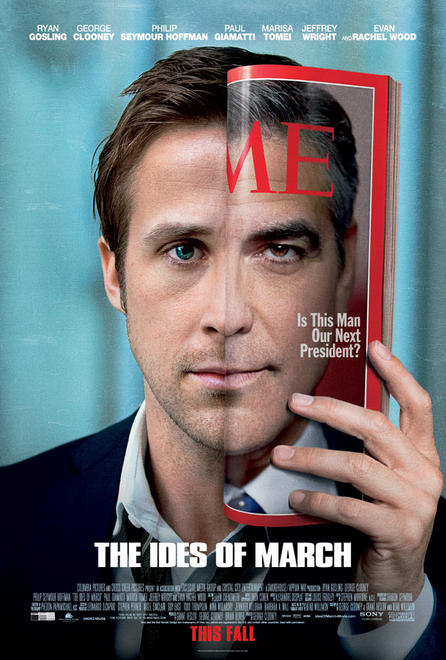
The Ides of March

The Ides of March
Two days ago, Henry Tang slacked off all the blame on the illegal basement to Mrs. Tang. "It's all my fault, not my husband" is what seems to be saying in Mrs.Tang's quiet weeping.

This total fisco just doubly proves how dirty the political world is, and that's what The Ides of March told us about. 

Stephen Meyers (Ryan Gosling) is the press secretary of Mike Morris (George Clooney), the governor of Pennsylvania and the Democrat presidential candidate. The story starts when Stephen, lacking political sensitivity, went out to meet the competitor's campaign manager. 

He belatedly told his boss, Paul Zara (Philip Seymour Hoffman) about the meeting but this honesty was not very much appreciated; Paul distrusted and fired him. That starts Stephen's revenge which eventually turned him into a soulless amoral person. 

This plot bespeaks a tragic moral fable. The most chilling scene is when Ida, the journalist who threatened Stephen to publish his meeting, came after Stephen has emerged unscratched by the scandal and asked him  'Hey, Steve. I'm still your friend, right?'

Without irony nor any emotion, he replied 'You are my best friend' - the ultimate descent to hypocrisy. 

George Clooney easily executed a relaxing judicious authority as what a governor should do. He listened to advices, asked the advisers and made his own mind. When asked about his view on capital punishment and what if the victim is his wife, he answered, without a moment of thinking, that he would kill the murderer.

Despite that, he is still against capital punishment, since 'The society must be better than the individual'. (Professor Choy has written a fantastic article on this here)

But this idealism is all too superficial when on the face of Stephen's threat, Morris simply gave up all his baselines. After all, a politician has no baseline in a political game, especially in an election running for the most powerful seat in the world.

In the political world, everything can be bought and sold for power; just like Henry Tang selling out his wife to continue running the CE election. 

Monday, February 13, 2012

THE SHINING

The Shining - Book Cover
Genre: Psychological horror 
Author: Stephen King 
Spoiler Warning: Minimal. 

Jack Torrance, a victim of a drunken father and battered family,  married with extremely emotionally sensitive Wendy to give birth to Danny, a child endowed with a highly charged psychic power. The story, The Shining, opens when this family moves into the Overlook Hotel, remotely located in mountain and is known to have a 'bad reputation'. 

Before moving, Jack, deep in alcoholism,  has lost his teaching job for assaulting one of his students and the Torrance family was on the verge of complete disintegration when Jack, in his drunken state, broke his son's arm for messing up his papers.

Hoping to get a fresh new start, Jack takes the caretaker job in the Overlook Hotel for winter. In the meanwhile, Danny's psychic power or 'shining' made him particularly susceptible to the supernatural foce in the Hotel; from the lady in room 217 to the unseen huge mask party in the ballroom. 

Wendy with her instinctual motherly love for Danny and her fear of increasing insanity from her husband, desperately wanted to get out and leave, but to no avail on the face of the greedy evil force in the Hotel. 

The relation between ghost and haunted memories/human weakness is like music and glass; when certain frequency of music resonates with glass, the latter breaks. In his last chance to decide leaving the Hotel or not, Jack simply let him get possessed by the evil force, since he can't bear losing the job again. 

Neither can he hold his thirst for alcohol anymore. When the bartender offered him the drinks (or hallucination?), Jack gave up and took it. One glass followed another until Hotel can possess him to swallow Danny and more importantly his psychic power. 

In this novel, Stephen King showed us that the greatest ghosts do not exists outside of us but in our psychological minds. 

Sunday, February 05, 2012

A Reply to Minna Ho

The Locust Ads
First, I do not agree using 'locust' to pinpoint Mainlanders. According to the Oxford Dictionary, 'locust' refers to ' a large, mainly tropical grasshopper with strong powers of flight. It is usually solitary, but from time to time there is a population explosion and it migrates in vast swarms which cause extensive damage to vegetation.'

From this definition, I do not find it inappropriate to use 'locust' in a metaphorical sense to describe any person or any group of people that 'enter' into a territory for the purpose of scraping off the domestic welfare, causing extensive damage to the local population. It seems obvious 'double non' pregnant women and children fall within this definition. 

Second, I didn't pick on Minna Ho's article because of any personal hostility to her. On the contrary, it is precisely because her article is so well - written and so convincing that compels me to write this reply, in spite of my very amateurish understanding of politics and laws. (her article is available here)

In essence, her argument may be summed up in the following ways: 
  1. The historical background behind the Basic Law and Article 24 has given the lawful right of abode to all children born in Hong Kong
  2. Before and after 1997, Hong Kongers have also migrated to foreign places for better welfare, not just Mainlanders. 
  3. The Hong Kong SAR government bears the responsibility for attracting Mainlanders. 

For the first point, we, the Hong Konger, never have the chance to vote in a referendum or through any other democratic processes on any part of the Basic Law during the Sino - British negotiation. The legality of their right of abodes does not imply their legitimacy. 

True, many Hong Kong families have migrated to other places but comparing Hong Kong's population size to Mainland, there must be more Chinese migrating than Hong Kongers. 

Further those who can afford to migrate are usually wealthy upper class, not the low - income families or the new couples in these 10 years. Why do the low - income families or new couples staying in Hong Kong have to suffer for what the rich minority has done (according to the logic in the article)?

Even if, we, Hong Kongers, did migrate for the sake of better welfare, so? What we have done is wrong does not mean the acts committed by 'double - nons' pregnant women are not wrong. They still bear the moral responsibility for consuming Hong Kong's welfare. 

The Hong Kong SAR government did permit Mainland pregnant women to come (for the moment) but it must be born in mind this government and our LegCo are never elected by universal suffrage. Strictly speaking, the government 's policies does not necessarily reflect our view. 

It remains to be seen whether Donald Tsang' s administrative measures will be working. Hopefully, the future government can have the gut to start the amendment process enshrined in article 159 of the Basic Law to eradicate the problem, once and for all. 

Sunday, January 22, 2012

Hong Konger - British Dog with Dragon Tattoo

'Those who refuse to speak Mandarin, what kind of people are they? Bastard!' '

Yesterday the SCMP reports 'An ultra-leftist mainland academic branded Hong Kong people "running dogs of the British government" when commenting on a quarrel between Hong Kong and mainland passengers on an MTR train.' (news here)

This 'ultra - leftist mainland academic', 孔慶東 (Professor of Beijing University and alleged 73rd generation descendant of Confucius) added a number of points, saying 'All Chineses have the responsibility to speak Mandarin... Those who refuse to speak Mandarin, what kind of people are they? Bastard!' (video here)

On the attitude of the HK passenger in the MTR, he said 'I have never seen Hong Konger treating Hong Konger, American and Japanese like that.' 

The answer is simple. American, Japanese or British, born in the advanced democratic rule - bound society and taught with civilized western etiquette, respect the rules of the area and simply do not eat in the MTR, along with a number of other basic things: not jumping the line and not excreting or urinating on the street.

Ming Pao adds 'Commentators point out conflicts between Mainland and Hong Kong have deepened, showing integration measures have not been effective'. (news here)

The worry is we can't integrate with the Mainland. If we can't get along well, then don't. Why so anxious about it?

What Anson Chan, the former Chief Secretary for Administration, has said 11 years ago still stands ' Some are so concerned about integration that they seem to forget that our strength lies in the separation which is fundamental to the success of One Country Two System - not just Hong Kong but for China as well' (In Retrospect and Anticipation, the luncheon address to the Asia Society Hong Kong Center)

The whole point of OCTS is the distinctiveness that Hong Kong should enjoy, from capitalism and rule of law to Cantonese and Traditional Chinese, instead of integrating with the Mainland.

The Europeans have long realized the unfeasibility of unification and have abandoned the idea of the Holy Roman Empire 500 years ago (officially dead in 1806).

In the 21st century, Sinologists in China, finding the notions of class conflicts and Chinese nation inadequate to justify the imperial rule in Tibet and One China doctrine, are anxious to develop the  Tian Xia  (天下, literally 'under heaven') concept - a return to the good and old Chinese imperialism under the Qing Dynasty. ( a fantastic analysis is available here)

Florence in Italy has her harmoniously symmetrical Renaissance art while Venice developed her own colourful painting. Similarly Quebec in Canada had her own rich French culture while the rest of Canada speak English.

I do not see any conflict for a tourist to see the grandeur of the Forbidden Palace in Beijing while he can submerge into the classic Greco - Victorian architectural design of the Peninsula Hotel.

Perhaps 孔慶東 and China still stand where the Europeans have already moved along - that is 500 hundred years ago. They first want Tibet, Taiwan and Hong Kong to kowtow, and then the rest of the world.

Well, perhaps, 孔慶東 is right. Having been separate since 1842, we are dogs, the ones who learn rule of law from British but inherit the beautiful Traditional Chinese writing - British dogs with dragon tattoo.

Saturday, January 14, 2012

Lost Language Found in China, 'a highly more advanced language than the existing Chinese', Expert said.

Oracle Bone Script
The news reports:

" Yesterday, a team of archeologists from the Oxford University has found a large stone slab in an island situated at the south coast of China, showing 'a highly more advanced language than the existing Chinese', said Dr. Liang, the head archeologist. 

The discovery, described in the Journal of Archeology, shows the first times that a lost civilization has once co - existed with the Chinese culture in the Mainland. 

'The characters are similar to Simplified Chinese but present greater complexity and far more beautiful pattern', said Tong Man - wu, the director of the Beijing - based National Calligraphy Institute 

That leads to the question - what caused the demise of this civilization? It was believed that colonization from the Mainland China has slowly replaced it with the present Simplified Chinese system. 'It's a pity', said Dr. Liang, 'It seems Chinese culture has gone backward'. "

Government Poster in Simplified
Chinese
The above report is a wholly invented news but it won't take long before you might really see it in the newspaper when we do not uphold the cores of Chinese culture - Traditional Chinese and Cantonese. 

All signs point to one direction: simplified (handicapped) Chinese is slowly encroaching into Hong Kong.   The media already reported the use of simplified chinese in government street signs at Sheung Shui. (news here) 

It can't be excused as blunder when another government poster used handicapped Chinese as well. (Picture on the right)


Another weapon that the Communist China employed to substitute Traditional Chinese and Cantonese is the huge exodus of Mainland Chinese. It is an horror to see from a government source that children whose parents are not Hong Konger have increased from 1.3% in 2001 to 36. 9% in 2010 (data below) - the beginning of the colonization. 

Birth Rate 

Nothing less is clearer when Stephen Lam, the Chief Secretary for Administration of Hong Kong, told us 'to look positively at the new influx of Chinese immigrants' who will prove to be 'new blood' of the population. (news here)

While Outer Mongolians use the Russian Cyrus character; Thailand adopts the Indian Sanskrit; English, French, German, Spanish and Italian share the Latin script, China develops her own beautiful Chinese characters - in which the illiterate peasant - classed Communist Chineses are quick to abandon.

In the movie The Flying Sword of Dragon Gate (龍門飛甲 ), the ancient Xi Xia characters (西夏文) in the stone slab have been so little known and so badly eroded by sand that they can hardly be recognized.

Not long, Traditional Chinese and Cantonese will become like Xi Xia language - destroyed and forgotten.

Monday, January 09, 2012

Cross Examination in the FB Gang Rape case

The Daily Cause List 

On 24 November last year, Apple Daily has reported a news on gang rape:

"【本報訊】 20歲學生涉嫌利用社交網站 facebook獵艷,接連兩日聯同四名朋友分別邀約五名未成年女網友飲酒狂歡,更用安眠藥當解酒丸將少女迷姦。其中一名 14歲女網友一夜間慘被男生及其三名男友人輪姦。男生強姦少女後竟向男友人叫喊:「喂!接棒吖!」"
(full news here, english version here)

The news report presents a neat story with clear plot line but the truth may have been far from it, with many questions left unanswered: 
  • Who gave the sleeping pills to the girls? 
  • Did each of them know the girls have taken the sleeping pills? 
  • Did they honestly believe the girls were willing to have sex with them?

The answer for each of these question is a matter of life and death for each of the defendant. A conviction on rape can attract imprisonment for life while the maximum penalty for unlawful sexual intercourse with a girl under 16 is merely imprisonment for 5 years. 

During the cross - examination of D2 (Yeung Man - chung), his Counsel tried hard to lead him to admit indecent assault, a still lesser offence, and to create an impression that D2 was not aware of the others' acts. 

D1's Counsel, sensing this might be unfavorable to his client, questioned D2 on his knowledge of the girls at D2's home, so that D2 may also have the intention to participate the raping: 

D1's Counsel: ' In the police interview, you said you know the girl was at home with M (another D). Now here at court, you said you did not know the girl was there. Why do you contradict yourself?' 

D2: 'I was not sure at the time but later found that out'

D1's Counsel: 'So that means you've lied during the interview?' 

D2: 'No, I have just said the wrong things during the interview'. 

D1's Counsel went on to cross - examine D2 and questioned him why during the police interview, he had only his underwear when he got into the room but now at court, he said he has only changed to underwear after he got into his room. 

All in all, D1's Counsel is trying to persuade the jury that D2 knew the girl was at his home and that he has been ready to participate in the rape. 

Prosecutor, on her part, cast her net as wide as possible so that all Ds may have been liable. One strategy she employed is to charge them with conspiracy, so that all of them had consensus to set up a plan for raping the girls. In particular, she asked D4 about the drug: 

Prosecutor: 'Have you heard about the drugs for absolving alcohol (解酒丸)?' 

D4: 'Yes, I do.' 

Prosecutor: 'Where have you heard of them? From other Ds?'

D4: 'I knew about them from other friends and from TV as well. I have seen girls in bars taking them'

Prosecutor: 'At the time, do you believe the drugs are for absolving the alcohol' 

D4: 'Yes, I do'

This part of cross - examination fits into her overall strategy on the conspiracy charge and also tried to disprove D4's alleged knowledge on the drug; D4 should have known those drugs are, in fact, sleeping pills (and may have intended to lure the girls taking them for the purpose of raping them)

Cross examination is much more interesting when the 5 defendants engaged in what is known as 'cut - throat' defence - i.e. each D incriminate the other co - accused Ds for committing the crime.

D4, for example, alleged in the court that during the police interview, he tried to reduce liability by telling a false version to the police, one in which he substituted into the role of M who has sexual intercourse with one of the girls. The M's counsel will try hard to disprove this claim and find the contrary evidence during the cross examination. 

Cross - examination is the process where each lawyer will try to advance their argument for the benefits of their clients. It can hardly be a way to find the truth, as most people might believe.

* All proceedings are, of course, conducted in Cantonese. Above is all my English translation from Cantonese. 

Sunday, January 01, 2012

When friendship burns - A reflection on 天與地 (When heaven burns)

Yan in When Heaven Burns

Despite all the noise and buzz on 天與地 (When Heaven Burns), let's boil it down to one theme: friendship.

Through music, they meet and through band, they form friendship. They clash and they reconcile. During a snowstorm,however, something happened that will crack an irreconcilable gap in their friendship; they ate Ka Ming, their best friend, to survive.

From this onward, they depart, which is not unusual. After all, you won't like to meet someone who knows you have eaten another human.

Life is like a pendulum. When you go to one end, the pendulum will swing back to another extreme. 鼓佬 (Joe) attempts to redeem his sin by living like an ascetic monk and fighting for the interests of workers. It's precisely this that he is destined to fail.

鼓佬's mentor 泉叔 (Kong Chiu Chuen), acting as his moral guardian, tries to guide him to the right path. He is fighting for  justice and welfare of workers, not to redeem his own sin.

Inevitably they clash when 鼓佬 runs for the legislative council's seat. He has shifted his attention to achieve success through whatever means; he is representing himself, not the workers. His final break with his moral guardian 泉叔 thus signals another phase of his life - 鼓佬 will swing from an ascetic monk to a unscrupulous career - seeker.

Instead of helping other people, 黑仔 (Angus) anesthetize himself by committing even more crimes. He manipulates women, lures people to play risky stock market index and then loan - sharks to them. Rather similar as 鼓佬, he has swung to another extreme after semi - liberate himself from his own guilt.

Only one person has stay unchanged: Yan (/Hazel, 葉梓恩). She does seem to waver and distrust people when it reveals her 3 best friends lied and have eaten her her boyfriend Ka Ming. A disillusioned woman with the exact same name 葉梓恩 has changed her mind. After being released from the prison, that woman killed her husband who has abandoned her before.

Yan knows she will be gotten into the same scenario if she continue to distrust and remain skeptical of everything. She will run into the same dead - end and get disillusioned.

鼓佬 and 黑仔 have always been the two oscillating forces. Ronnie got trapped in this field of force and was unable to move. Both of them love Yan; when they got rid of Ka Ming, partly on survival instincts and perhaps partly on jealousy, they will be destined to clash - not necessarily for love, but definitely to outcompete for the sake to outcompete.

Each with their clashing personalities, fate has driven them to meet after 18 years. Their friendship burns not to glow, but to get self - destructed into ashes. 

Monday, December 26, 2011

Movie Review: 龍門飛甲 (The Flying Swords of Dragon Gate)

The Flying Swords of Dragon Gate

Director: Tsui Hark
Cast: Jet Li, Zhou Xun, Chen Kun, Kwai Lun - mei and Li Yu - chun
Overall: 7.5/10
Spoiler Warning: Minimal. 

Continuing his theme in Detective Dee and the Mystery of Phantom Flame last year,  Tsui Hark in The Flying Swords of Dragon Gate tells us one simple truth: power corrupts and perishes while trust and love, the Wuxia values, last.

In contrast to the all too realistic fighting in Ip Man, you'll see swords, flying daggers, chains and sharp silk lines whirling in the air. As Wuxia master, Chow Wai - on (Jet Li) elegantly fights with sword, while the devious Eunuch Yu Hua - tian (Chen Kun) hides his sword under his flipping robe. 

Still the beautiful Tartars Princess (Kwai Lun-mei) close - fights with a style akin to the Mongolian wrestling and also fights with a crescent that again tries to engage enemies as closely possible. Further, Gu Shaotang (Li Yu - chun) threw daggers that fly in a predictably unpredictable course. 

All these are done under the 3D effect which is not great, but acceptable. The 3D is still crude and undeveloped and it can hardly accomodate all the spinning and swirling of weapons and people. Nevertheless it does give some eye - opening surprises, particularly when Chow broke through the flag to kill  the Eunuch at the opening. 

Despite the martial art and the 3D effect, the plot is so weak that it renders all the characters as two - dimensional flat sheets. We never really know what has happened in the love story between Chow and Ling Yan - qiu (Zhou Xun), nor do we know how others have come together for the treasure hunt. 

Fortunately this did not stop Chen Kun playing the scheming Eunuch on one hand, and the blissful Wind Blade, on the other. The parts where Chen imitated the Eunuch to fool other people has added much lively element in the middle of the movie. Kwai has also unusually plays well the passion of the Tartars people.

Tsui interestingly put the very traditional Wuxia music, Dagger Society Prelude (小刀會序曲), at the opening and closing scenes, perhaps at a tribute to old Wuxia movies. 

The movie ends with the Eunuch, symbolizing lust for power and wealth, buried deep in the sand, while Chow has taken his turn to find his love, Ling, till the end of the world. In the world of Wuxia, love is perennial.